
Angelman Syndrome: Deletion
A deletion is the most common genetic cause of Angelman syndrome, affecting about 70% of individuals living with AS.

What it means
The maternal copy of the UBE3A gene is missing.

How common is it
About 7 in 10 individuals living with AS have a deletion.

Is it inherited?
Usually no. In most families, it occurs randomly.
What is Deletion AS?
The most common cause of AS is that the UBE3A gene is missing, or deleted, from the maternal copy of chromosome 15. Because the maternal UBE3A gene is missing and the paternal UBE3A gene is turned off, a person with a deletion of the maternal UBE3A gene does not make any UBE3A protein in the neurons in the brain. This is also called deletion positive AS.
A note about terminology. This page covers the larger chromosome 15 deletion that commonly causes Angelman syndrome. Smaller deletions involving the imprinting center or part of the UBE3A gene are different genotypes and are covered separately.
A simple way to think about it.
One copy of the gene is missing. The other copy is naturally silenced in the brain.
That is why deletion of the maternal copy of UBE3A causes Angelman syndrome.
What can deletion mean for my loved one?
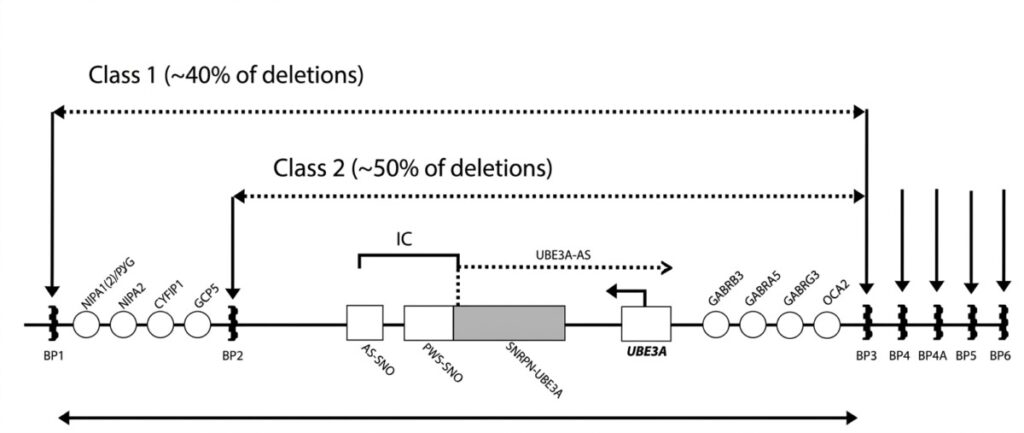
Individuals living with AS deletions are often missing not just UBE3A but also 8-12 other genes. This means they are missing 5-6 MILLION base pairs of DNA on the maternal chromosome 15. The other missing genes may also contribute to learning difficulties, seizures, lighter coloring, and more. All together, this makes the features of those living with AS deletion generally more severe than the other genotypes.
Most individuals living with AS deletions have either a Class 1 or Class 2 deletion (also sometimes referred to as Type 1 or Type 2 deletion). The class is determined by where the deletion starts and where it ends.

Questions about Deletion AS?
FAST’s genetic counselor, Niki Armstrong, can help you better understand your loved one’s genotype and what it means for your family.
Schedule a 1:1 AppointmentCould this happen again in our family?
In most families, Deletion AS is not inherited. Testing of the mother can clarify your family’s specific chances for a future pregnancy.
Nothing a parent did or did not do before or during pregnancy caused this.
Family Testing and Future Chances
Deletion randomly occurred during the formation of the egg and was NOT inherited
Deletion occurred as a result of a maternal chromosome difference
Chance for Deletion AS in future pregnancies is <1%. This chance is higher than the chance for someone who has no child living with AS, because there can be more than one egg with the deletion.
Chance for Deletion AS in future children may be as high as 50% but depends on the exact chromosome difference.
Other family members do NOT have an increased chance to have a child with Deletion AS.
Other family members may carry the rearrangement and have an increased chance to have a child with Deletion AS. They may wish to consider chromosome testing to understand their chances.
If Deletion AS usually isn’t inherited, how does it happen?
The region on chromosome 15 around UBE3A has sections that have similar repeated patterns, which can sometimes affect the making of eggs and sperm.

Are there clinical trials for individuals living with Deletion AS?
Historically, all clinical trials in Angelman syndrome have included individuals living with Deletion AS. This is because Deletion AS is the most common type of AS and generally considered the most severe. Each clinical trial is different in its criteria for participating, but typically the clinical trials have included at least Class I and Class II deletions.
Keep Learning & Find Support
Genetics 101
Learn More
Newly Diagnosed
Learn More