Home/Genetics 101

Understanding AS Causes and Potential Treatments

Angelman syndrome is caused by genetic changes that affect UBE3A, a protein that is especially important for brain development and function. This page explains the essential genetic concepts to understand Angelman syndrome.

The basics: chromosomes, genes, and proteins

The human body is made up of cells. Inside most cells are 46 chromosomes, arranged in 23 pairs. We inherit one copy of each chromosome from our mother and one from our father.

Chromosomes package DNA, the genetic information inside our cells. Each chromosome contains many genes, which are sections of DNA that are the instructions for making proteins. Proteins carry out many of the functions cells need to develop, communicate, and respond to their environment.

The UBE3A gene and chromosome 15

The UBE3A gene is located on chromosome 15 and provides instructions for making UBE3A protein, which is especially important for healthy brain development and function.

Most people have two copies of chromosome 15, including two copies of UBE3A: one inherited from the mother (maternal) and one inherited from the father (paternal).

How imprinting works

In most cells of the body, both maternal and paternal copies contribute to UBE3A protein production. In neurons, however, the maternal copy is the primary source of UBE3A protein. The paternal copy is typically silenced through a normal process called imprinting.

In Angelman syndrome, the maternal copy of UBE3A is missing, altered, or not functioning properly. Because the paternal copy is normally silenced in neurons, the brain does not produce enough functional UBE3A protein.

Why does this matter?

Angelman syndrome is unusual because a paternal copy of UBE3A is often present in neurons, even though it is naturally silenced. This creates an important opportunity for researchers studying ways to restore UBE3A function.

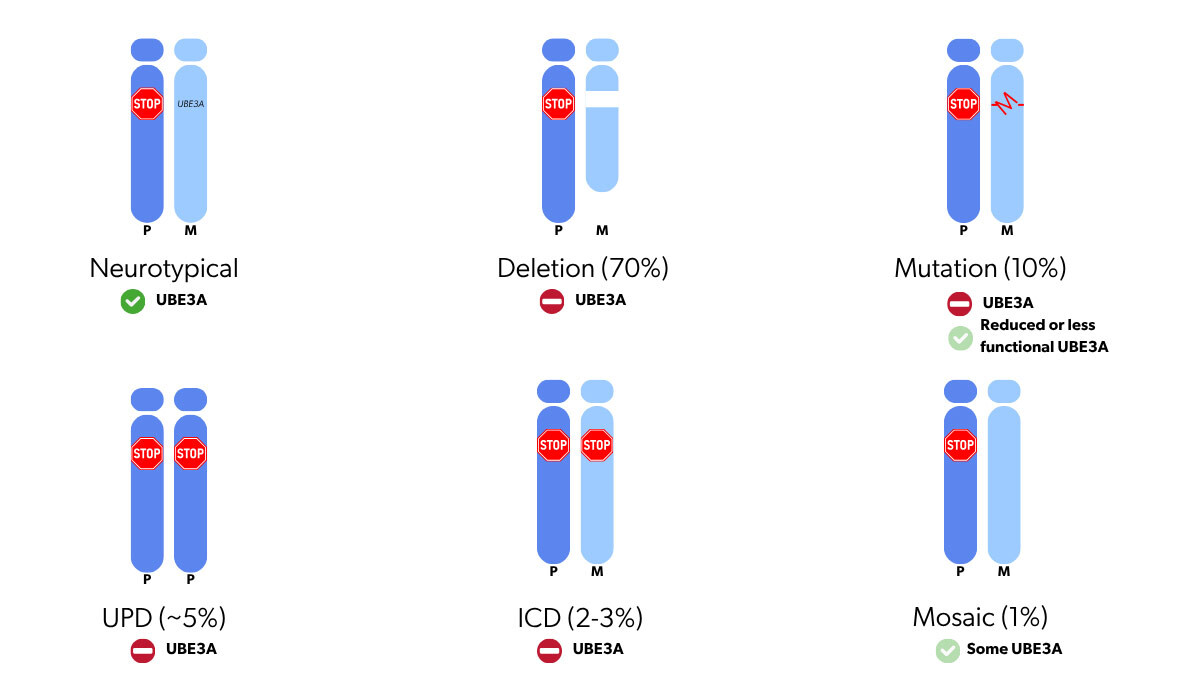
What causes Angelman syndrome?

Angelman syndrome can result from several genetic mechanisms, often called genotypes. 

Different genetic mechanisms, shared outcome: each genotype results in too little functional UBE3A protein in the brain.

Why UBE3A protein matters

UBE3A protein plays an essential role in healthy brain function. It helps regulate other proteins within cells and supports communication between neurons.

Scientists are still learning about the full range of effects when UBE3A activity is reduced. What is clear is that UBE3A is important for brain development and the way neurons communicate, helping explain why Angelman syndrome can affect learning, movement, speech, sleep, and seizure risk.

Can Angelman syndrome be inherited?

In most families, Angelman syndrome is not inherited. The genetic changes that lead to Angelman syndrome typically occur as random, or sporadic, events during egg or sperm formation or early embryonic development.

In some families, Angelman syndrome can be inherited. This is most often associated with Mutation AS or ICD-Deletion. Understanding the specific genotype is critical for determining chances for other family members and for testing family members

Need help interpreting a result?

FAST genetic counselors can help families understand a diagnosis, genotype, and questions about inheritance or family planning.

Schedule a 1:1 Appointment

Developing treatments for AS

The genetics of Angelman syndrome create several potential paths for treatment development. Researchers are studying ways to restore UBE3A function, reactivate the silenced paternal copy of UBE3A, and address the downstream effects of reduced UBE3A activity in neurons.

FAST’s Roadmap to a Cure

FAST organizes these opportunities into five connected research pillars, from early scientific discovery through the tools and infrastructure needed to move promising programs toward clinical development.

  1. Replace Mom’s UBE3A
  2. Turn On Dad’s UBE3A
  3. Explore Adjacent Genes
  4. Target Downstream Pathways
  5. Accelerate and Prepare for Clinical Trials

Keep learning

Explore deletion, pathogenic variants, UPD, imprinting center defects, and mosaicism in more detail.

Learn how testing confirms Angelman syndrome and identifies the underlying genetic mechanism.

Find a clinical trial for your loved one.

What are you looking for?

Find information on Angelman syndrome, research, clinical trials, resources, and ways to get involved.