
Our History
Building Progress Since 2008
From 2008 to today, the Foundation for Angelman Syndrome Therapeutics (FAST) has helped shape the modern landscape of Angelman syndrome research by building what did not exist before: the collaborations, the infrastructure, and the paths from laboratory to treatment.
That work has helped FAST grow from a parent-founded organization into the leading patient advocacy organization working to cure Angelman syndrome and the largest non-governmental funder of Angelman syndrome research in the world.
2008
Progress Could Not Wait
When FAST was founded in 2008, Angelman syndrome was a largely overlooked condition. There were no clinical trials, few researchers focused on the condition, and no clear path for turning scientific discoveries into potential Angelman syndrome treatments.
Founded by Paula Evans and a small group of determined parents, FAST was built on a simple belief: families could no longer afford to wait for progress to happen on its own.
Rather than accepting the pace of Angelman syndrome research, FAST chose to identify the barriers slowing progress and build what was needed to overcome them. Sometimes that meant funding research. Other times it meant creating new tools, new partnerships, new companies, or entirely new ways of moving science forward.
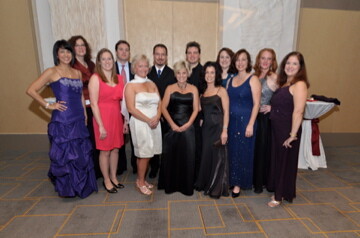
Founding Board of Directors
FAST was founded by Paula Evans and a volunteer board of parents committed to changing the future of Angelman syndrome:
Elke Sprow • Reggie Hamm • Becky Burdine • Sharon Claridge • Maiddy Dunigan • Melissa Elkins • Kena Richert • Erin Sheldon • Terry Sullivan • Karen VanPuyenbroeck Doyle • Sharon Weil-Chalker
2010
One Organization Became a Global Movement
Families around the world shared the same urgency.
Beginning with FAST Australia in 2010, organizations across multiple countries–including the United Kingdom, Canada, Italy, France, Latin America, Poland, and Spain–joined together around a common goal: accelerating research and development for Angelman syndrome.
Today, FAST’s global affiliates strengthen research, expand awareness, and connect families, scientists, clinicians, and industry partners across 22 countries around the world.

Canada
Latin America
United Kingdom
Poland
Italy
Australia
France
Spain
2013
Collaboration Changed Everything
As research expanded, FAST recognized another challenge: even the best scientists often worked independently, slowing the exchange of ideas and limiting opportunities to build on one another’s discoveries.
In 2013, with support from the Azout Family, FAST launched the FAST Integrative Research Environment (FIRE), an idea conceived by Dr. Becky Burdine and led by Dr. Ed Weeber, alongside Drs. David Segal, Scott Dindot, Anne Anderson, and Kevin Nash. FIRE brought together researchers from multiple institutions to collaborate directly, rather than working in separate silos.
2015-16
Hope Needed a Plan
As scientific opportunities accelerated, FAST recognized that funding alone wasn’t enough. The research community needed a shared strategy.
Dr. Allyson Berent, who joined FAST’s board in 2015 and became Chief Science Officer in 2016, worked alongside the board, the FIRE team, and researchers new to Angelman syndrome to develop FAST’s Roadmap to a Cure: a plan built on a clear need, a clear path, and a clear price tag for each approach.
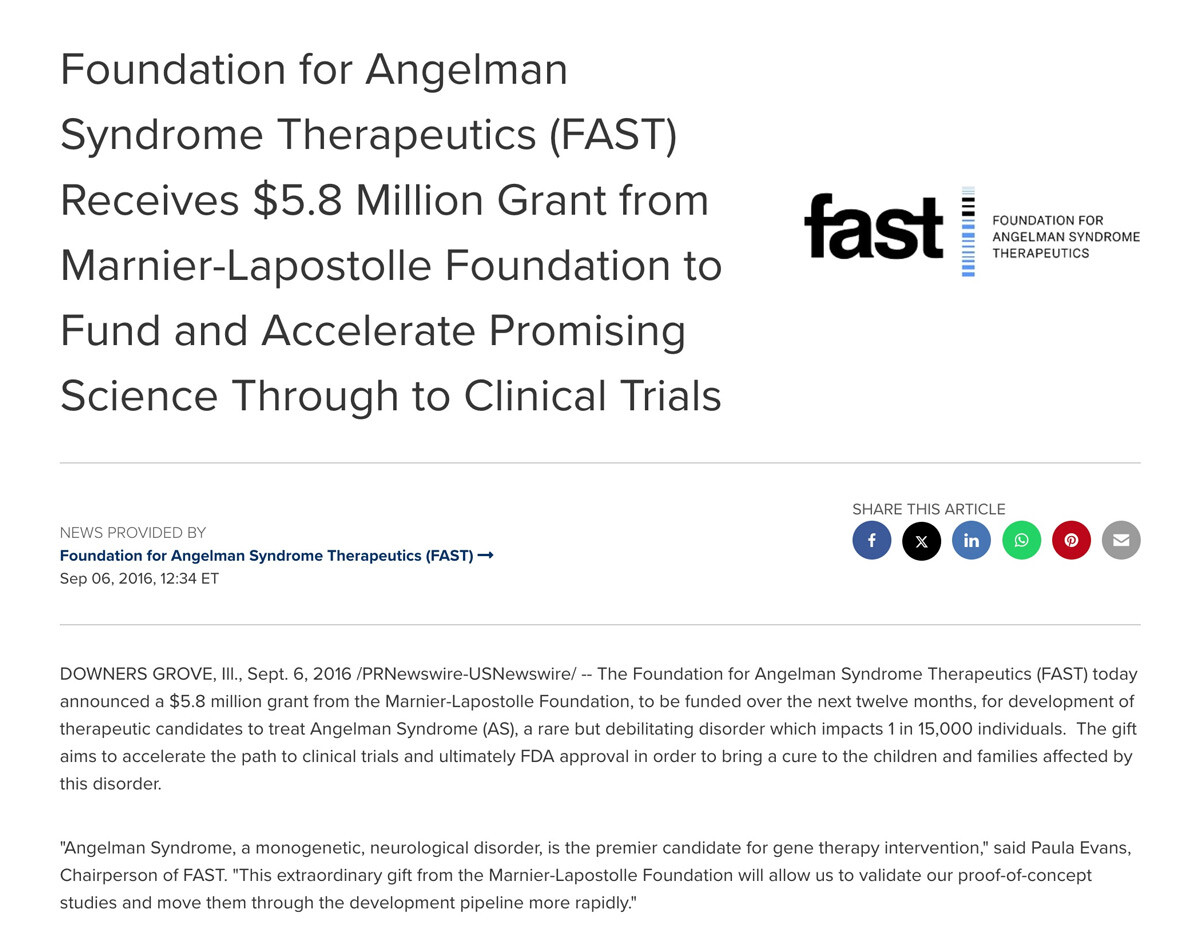
The roadmap identified six disease-modifying strategies considered the most promising at the time, each with its own cost attached. Together, they totaled $5.8 million. For the first time, the Angelman syndrome community had a coordinated plan for translating scientific discovery into potential Angelman syndrome treatments.
2016
Six Chances Instead of One
In 2016, the Marnier Lapostolle Foundation, established by the family behind Grand Marnier liqueur and inspired by their own family member living with Angelman syndrome, made a transformational $5.8 million investment that fully funded FAST’s Roadmap to a Cure.
Most rare diseases are lucky to have one or two viable research strategies. This gift gave the Angelman syndrome community six shots on goal at once.
2018
Discovery Became Development
Promising Angelman syndrome research often stalled between academic discovery and commercial development: a lab could show a therapy worked, but had no way to carry it toward patients.
To help bridge that gap, FAST created GeneTx Biotherapeutics to advance one of the most promising antisense oligonucleotide (ASO) programs in Angelman syndrome research. In 2022, on the strength of promising interim data, GeneTx was acquired by Ultragenyx Pharmaceutical, demonstrating that discoveries supported by FAST could successfully move from academic research into biotechnology and continue advancing through clinical development.
2021
From Separate Labs to One Table
As the Angelman syndrome research community grew, so did the need for deeper collaboration across academia, industry, clinicians, regulators, and patient organizations.
FAST helped launch INSYNC-AS to create a forum where the people responsible for advancing therapies could work together, share knowledge, and solve challenges collectively.
2022
Building a Permanent Home for Progress
As more therapies moved toward clinical trials, the field needed experienced centers capable of evaluating them.
In 2022, FAST established the RUSH F.A.S.T. Center for Translational Research, creating dedicated infrastructure to advance translational science, strengthen clinical readiness, and train the next generation of Angelman syndrome researchers and clinicians.
That vision became reality in 2025 with the opening of the center, creating a permanent home for collaborative research, clinical expertise, and future therapeutic development.


2024
Building the Next Generation
FAST has always adapted its approach as science has advanced. As more therapeutic programs emerged, some needed more than funding: they needed dedicated scientific leadership and hands-on development expertise to keep moving forward.
FAST established AS²Bio Inc., a drug development accelerator, to meet that need. Rather than each program building its own team from scratch, AS²Bio provides shared managerial talent, infrastructure, and resources across every program it oversees, helping new companies move from proof-of-concept toward first-in-human trials. It already manages MavriX Bio, advancing an AAV-delivered gene replacement therapy for Angelman syndrome, and CourageAS Bio, advancing a gene-editing therapy.
Today
We Are Still Building
Today, Angelman syndrome has one of the most active therapeutic and drug development pipelines in rare disease.
ACTIVE THERAPEUTIC PROGRAMS
across multiple approaches, including three in investigational clinical trials
PROGRAMS FUNDED BY FAST
across the broader pipeline
INVESTIGATIONAL THERAPEUTICS
in human testing
FAST continues to invest in the science that makes therapeutic development possible: the biomarkers that prove a treatment is working, the natural history data that shows how Angelman syndrome changes over time, and the clinical infrastructure needed to run trials well.
Every milestone in FAST’s history began the same way: by recognizing something the field needed and deciding to build it.
That work continues today. As science advances, FAST will keep asking the same question: what does the Angelman syndrome community need next?
Because building progress takes all of us.
[Updated October 2026]